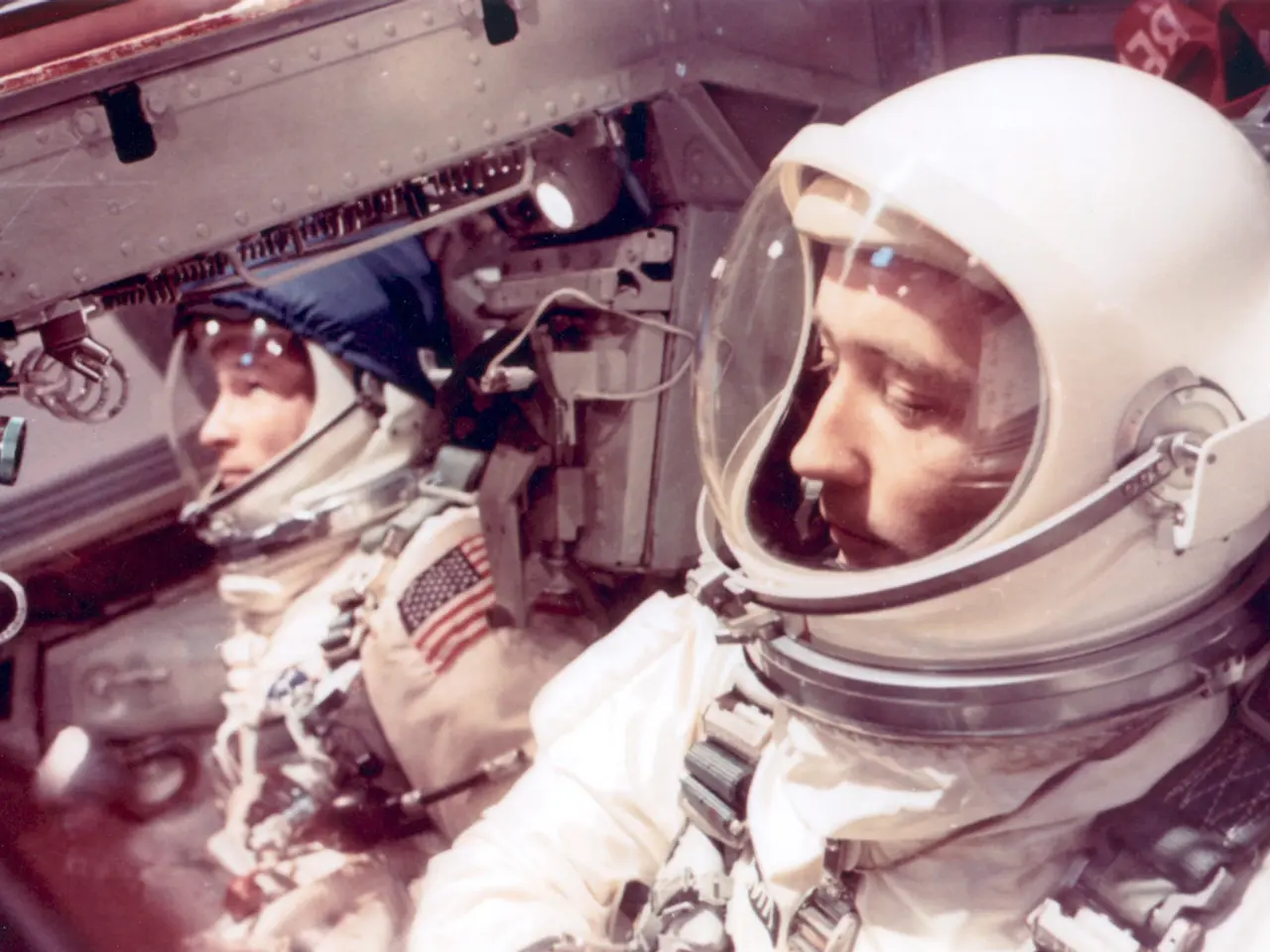
Boeing sends off astronauts on their inaugural space flight
On June 5, 2024, history was made as Boeing's Starliner capsule launched from Cape Canaveral, carrying NASA astronauts Barry E. Wilmore (commander) and Sunita Williams (pilot) to the International Space Station (ISS) [2][3][5]. This mission, known as the Crew Flight Test (CFT), is a significant step forward in the commercialization of space travel and a crucial milestone for Starliner's certification for regular manned missions.
The mission's original objective was an 8-day test flight to demonstrate Starliner's crew transport capability under NASA’s Commercial Crew Program before regular operational missions [1][3][5]. However, the journey to this point has been fraught with delays and technical challenges.
Delays and History Before CFT
Boeing Starliner was contracted in 2014 with an initial readiness target around 2017 [1], but key design and management issues caused multiple delays. The spacecraft had two uncrewed test flights: the first in December 2019 which failed to reach the ISS due to a timing software error and communication issues [1][5], and a successful second uncrewed test in May 2022 that docked at the ISS [1][5].
Delays Around the CFT Launch in 2024
Starliner was placed on the Atlas V rocket in April 2024, but the mission faced multiple launch postponements due to technical problems. Oxygen valve issues on the Atlas V rocket delayed the first attempt (May 7), a ground computer failure delayed the second attempt (June 1), and ongoing helium leaks in the service module further complicated preparations [3]. The final successful launch occurred on June 5, 2024, with docking at the ISS the following day [3][5].
Issues and Mission Adaptations During CFT
During approach to the ISS and the mission itself, Starliner experienced thruster failures (five thrusters failed) and persistent helium leaks affecting its propulsion system [3][5]. Due to the risk these problems posed to a safe reentry, NASA decided to postpone returning the astronauts on Starliner. Instead, the crew stayed on the ISS beyond the planned week and returned to Earth later aboard a SpaceX Crew Dragon spacecraft in March 2025 [3]. Starliner itself returned uncrewed on September 7, 2024, landing successfully in New Mexico [3].
Objectives of the Crew Flight Test (CFT)
The CFT aimed to validate Starliner’s ability to safely launch, dock with the ISS, support astronauts in orbit, and return safely to Earth under crewed conditions. It also sought to confirm and demonstrate the spacecraft’s performance and operational readiness for regular astronaut transport missions as part of NASA’s Commercial Crew Program [1][3][5].
The astronauts aboard the Starliner spacecraft, Wilmore and Williams, have a combined flight experience of over 11,000 hours as former U.S. Navy test pilots. During their stay on the ISS, they will perform manual maneuvers, test emergency scenarios, and conduct debriefings to ensure the Starliner capsule is ready for longer operational missions.
The CFT is a testament to the perseverance and determination of NASA and Boeing to overcome technical challenges and achieve their goals. It marks a significant step forward in the commercialization of space travel, and it symbolizes the integration of commercial space travel into NASA's human space missions. If the CFT is successful, Starliner could perform its first operational crewed mission in 2025.
The launch of the Starliner-1 mission also signifies that NASA's commercial crew program now has two manned spacecraft independent of traditional government systems: Boeing's Starliner and SpaceX's Crew Dragon. This development is expected to no longer depend on the Russians for human space travel, since the retirement of the U.S. space shuttle program. The launch on June 5, 2024, was a historic date in space exploration, marking nearly two decades of preparation to integrate commercial vehicles into NASA's human space missions. The U.S. Navy's Atlas V rocket, which transported astronauts for the first time in its 22 years of operations, played a crucial role in this mission.
The CFT's objectives, beyond launching and docking the Starliner capsule, included validating the spacecraft's ability to sustain astronauts in orbit using science and technology, and ensuring its readiness for regular sports events like long-duration missions [1][3][5]. The CFT also aimed to bridge the gap between space-and-astronomy and commercial industries, paving the way for regular manned missions in sports and science sectors.
Despite encountered delays and technical issues, the successful launch of Starliner-1 marked a milestone in sports history, symbolizing the integration of commercial flights into NASA's human space missions and space exploration [3][5]. This achievement showcased the merger of sports (space travel) with both science and technology, further popularizing space-and-astronomy among the public.